Blackridge — AI Runtime Economics
Provider invoices tell you how much. Blackridge tells you what for.
Blackridge, by Northwatch Systems
Your AI bill went up 40%. Nobody can tell you why.
Blackridge traces every dollar of AI spend to the workflow, the team, and the decision that caused it — and hands you a cause file: evidence finance can trust and engineering can reproduce. Not another dashboard of totals.
Northwatch Systems was founded by principal-level infrastructure engineers who spent the last decade running platforms where every dollar had to be explained: 33M+ users, 40M+ telemetry rows evaluated in real time, 17 regulated U.S. jurisdictions. We've been on the receiving end of the "why did the bill double" email. Blackridge is the answer we wished existed.
5 design partnersAccepting for Q3 2026
33M+ usersInfrastructure pedigree
17 jurisdictionsRegulated systems
OpenAI and Anthropic primary; others scoped per partner
OpenAI
Anthropic
Gemini
Azure OpenAI
AWS Bedrock
Self-hosted
The cause file
This is what you walk away with.
A cause file names the workflow, the root cause, the owner, the evidence rows, and what the fix is worth — separated into what we observed and what we modeled, with confidence and coverage on every claim.
The provider bill says April rose 40%. It cannot explain which product behavior changed.
Blackridge follows the traffic back to one support-agent workflow and the branch that fanned out.
Observed waste, modeled opportunity, owner, confidence, coverage, and evidence rows ship together.
quick-demowalkthrough · sample cause file
Quick DemoShows the path from workflow-level spend to row-level evidence and the request inspector behind a selected ledger entry.
workflow-tracesfrom a design-partner deployment, re-scaled and anonymized
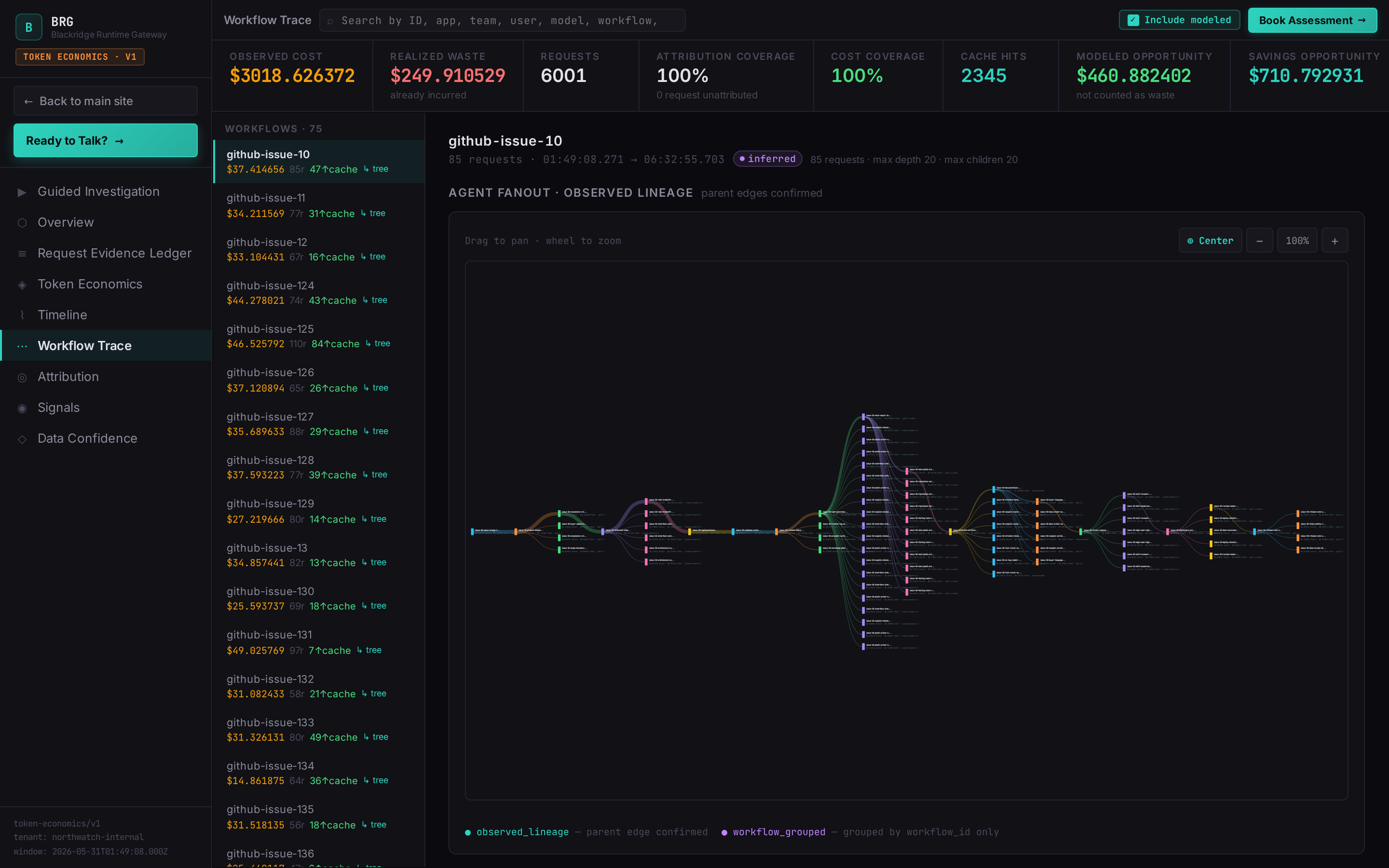
Workflow TracesAnswers: which workflow leaked spend, where the fanout happened, and which branch deserves the first engineering review.
request-ledgerrow-level proof · request inspector attached
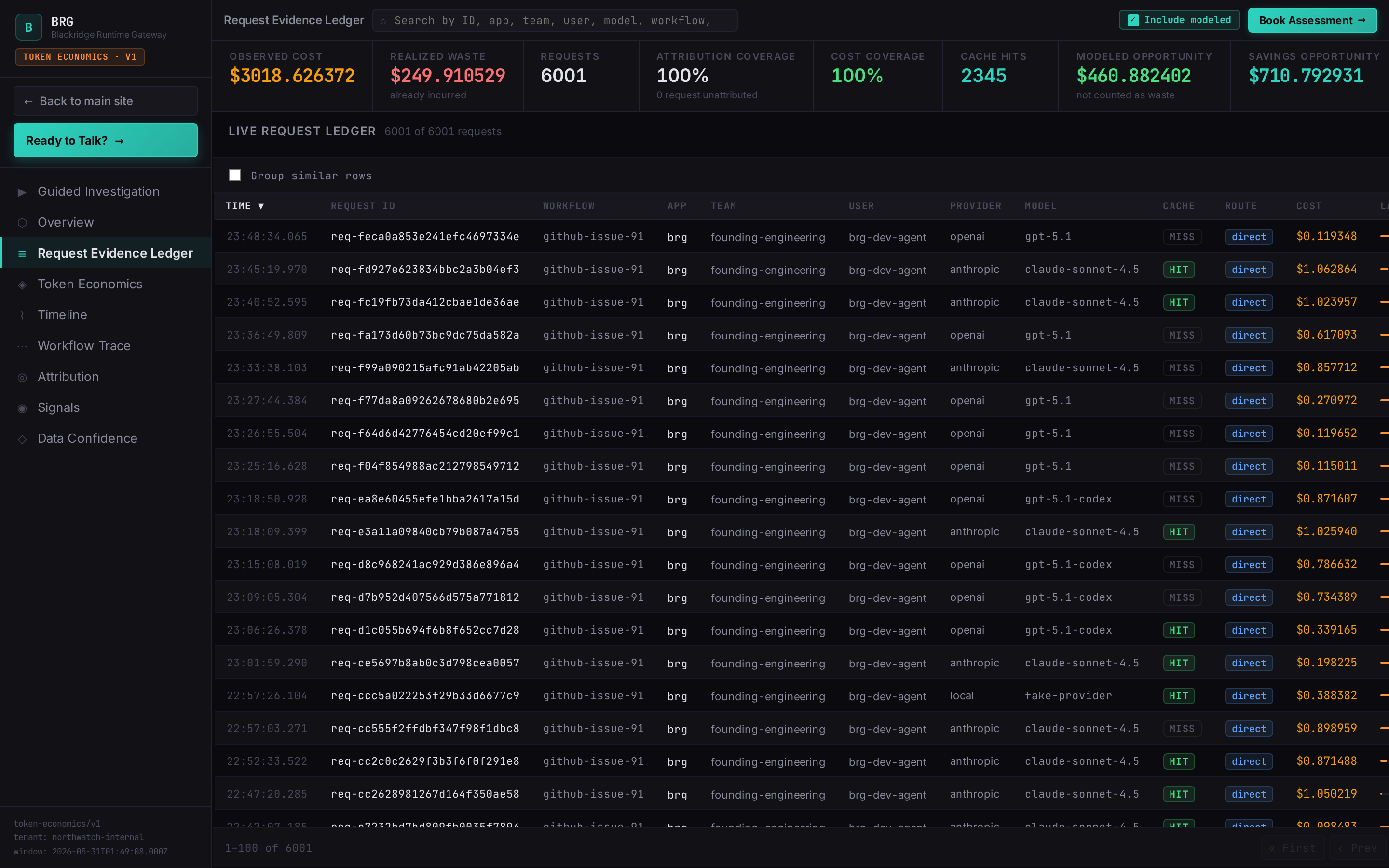
Request LedgerAnswers: which rows support the claim, what is observed versus modeled, which request was inspected, and whether finance can trust the number.
request-inspectorselected ledger row · anonymized fields
Selected row drill-down
One request, all the economics behind it.
The inspector is not another dashboard view. It is the evidence drawer for a ledger row: provider cost, attribution, usage, cache verdict, route plan, and timing.
Costprovider, estimated, selected, observed delta
Attributiontenant, app, team, user, workflow, logical operation
Runtime statecache, route, model, timing, usage status
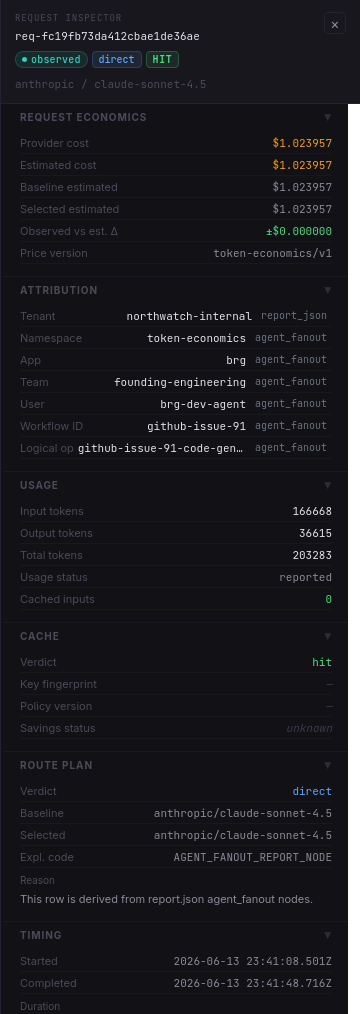
Request InspectorAnswers: why this selected row cost what it did, which attribution fields were present, whether cache/route state mattered, and what evidence is safe to share.
Provider cost, usage, route, cache, latency, and attribution are attached to request-level evidence.
Projected savings never get blended into realized waste. Finance sees the split before the headline.
Every finding shows confidence, workflow coverage, and the ledger rows an engineer can reproduce.
Published methodology
Audit the math before you talk to us.
The Blackridge docs explain evidence grades, attribution rules, coverage boundaries, reproducibility hashes, and how a cause file separates observed waste from modeled opportunity.
Every claim carries its evidence class so finance and engineering can see what was counted and what was modeled.
Missing owners and coverage gaps stay visible instead of being spread across teams as false precision.
The methodology is published so platform teams can inspect the evidence chain before a sales call.
Where AI money leaks
Six ways AI budgets bleed. Blackridge names all of them.
Each class maps to a painful question your bill usually cannot answer. Blackridge ranks what is observed, what is modeled, and what engineering can test safely.
Zero attribution
Spend exists, but nobody can assign it to an app, team, tenant, workflow, or customer.
Question: who owns this?Retry amplification
A single user action fans out into repeated model calls during soft failures.
Question: why did one action bill many times?Duplicate inference
Similar prompts or semantic duplicates are paid for repeatedly.
Question: did we pay twice for the same work?Fallback tax
Failures silently route to more expensive models or providers.
Question: when did premium become default?Premium-model overuse
Expensive models become defaults for work cheaper models could handle.
Question: which calls need the expensive model?Abandoned branch waste
Agent branches call models or tools but never affect the final answer.
Question: what was computed then discarded?The platform
From spike to cause to fix — with the receipts attached.
Blackridge is the AI Runtime Economics platform: cost attribution, economic forensics, workflow reconstruction, and financial evidence for every model call your company makes.
Here's the spike.
$3,018.63
48-hour workflow spend
Here's why.
Blackridge cause file
CauseRetry amplification 3.2×
Workflowsupport-agent / triage
Ownersupport platform team
PatternNo fallback configured
ProviderClaude degraded · latency spike
ConfidenceHigh — observed in 287 request rows
Here's the fix.
Add retry budget and fallback routing
Cap amplified retries, preserve the approved fallback path, and test cache coverage on the repeated context.
Estimated monthly savings
$4,100
01See the spike$3,018.63 over 48 hours, with $710.79 avoidable: $249.91 realized waste plus $460.88 modeled opportunity.
02Understand the causeBlackridge traces spend to a workflow, an owner, a pattern, and a confidence level.
03Know the fixThe 48-hour finding annualizes to roughly $3.7K/month, with modeled cache and fallback opportunity taking the expected value to about $4.1K/month.
How it works
How the numbers get this exact.
Your provider bill is one number. Behind it: hundreds of workflows, retry storms, oversized context windows, agents calling agents, and a model upgrade someone shipped on a Tuesday. When finance asks why April doubled, the honest answer today is "we're not sure." That answer gets more expensive every month.
Every call is attributed
Workflow, team, tenant, and cost driver — down to the individual decision that made it expensive.
workflow
team
tenant
cost driver
Evidence becomes lineage
Requests, retries, branches, and context choices assemble into a reconstruction of how the money was actually spent.
You get a cause file
A finance-ready report: where the spend leaks, what caused it, and what fixing it is worth. Observed vs. modeled, never blended.
CauseRetry amplification
Proof18 rows
Coverage63%
Exact because it's in the path
Blackridge runs inline as a pass-through collector: it observes and attributes today — it doesn't block, rewrite, or reroute anything. Inline position makes the numbers exact instead of sampled, and makes enforcement possible the day you want it. Fail-open: if Blackridge is unreachable, your traffic proceeds untouched. Read the security posture →
Overhead<5ms p99
On outageFail-open
Common questions
Use what you already have. Blackridge fills the cause gap.
Most teams already have logs, observability, and provider billing. Blackridge turns those signals into spend explanations finance and engineering can inspect together.
"We already have observability."
Datadog tells you latency and errors. It does not tell you which product decision made your token bill double. Blackridge answers the finance question, not the uptime question.
"Our spend is not big enough yet."
The pattern that costs $3K/month at your size costs $300K/month at the size you are planning for. The cheapest time to find it is now.
"An inline gateway? Platform and security will have questions."
They should. Pass-through only, no payload retention, fail-open with a documented bypass path, single-digit-ms overhead, and a one-workflow start instead of all traffic. We'll sit in the security review with you.
Built by the people who answer the pager
Northwatch Systems builds the economic infrastructure for AI operations.
Blackridge is our flagship platform — built design-partner-first by the founding engineers who wrote the code and take the pager.
Free review
Get your AI bill explained. Free.
Send us your work email. Within 2 business days you'll get a founder-written assessment of where companies like yours typically leak AI spend — and whether Blackridge would find anything worth your time. No fit, no pitch, we'll say so.
We'll never ask for credentials, payloads, or logs by email.